Bridging Quantum and Exascale: The Next Computing Revolution
The race to connect quantum computing with exascale systems is heating up, as experts envision a future where these two powerful paradigms work in tandem rather than in competition. Quantum computers excel at solving specific complex problems, while exascale supercomputers handle massive classical simulations. Together, they promise breakthroughs in materials science, cryptography, and artificial intelligence. This Q&A delves into what this union means, the challenges ahead, and the key players driving the transformation.
What is the role of quantum computing in relation to classical computing?
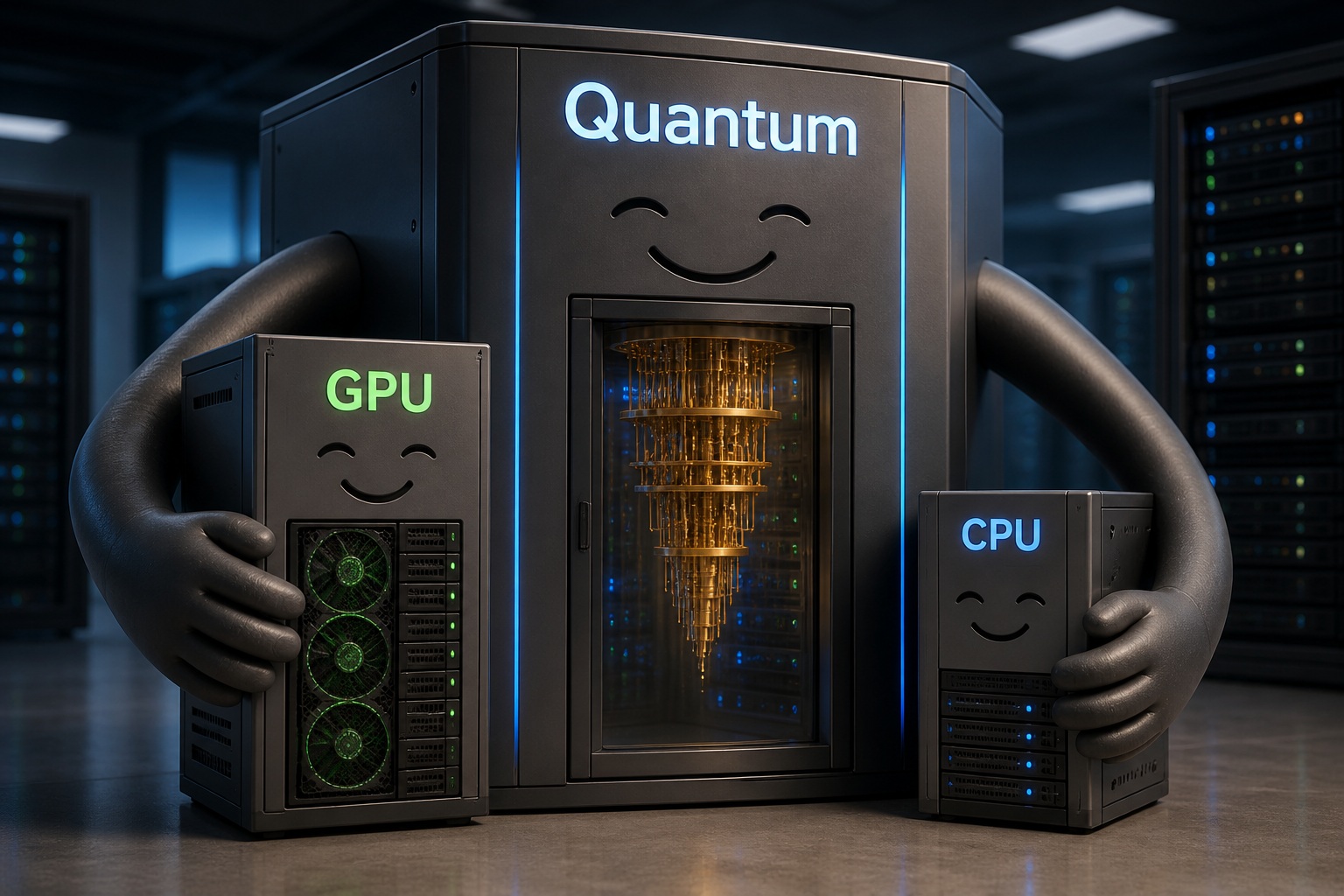
Quantum computing is not designed to replace classical architectures like CPUs and GPUs. Instead, it acts as a complementary accelerator for specific tasks. Classical computers handle everyday operations and large-scale simulations, while quantum processors tackle problems that are intractable for classical machines—such as factoring large numbers, simulating quantum systems, and optimizing complex logistics. Industry experts believe that all three will drive innovation for years to come. The key is to identify which parts of a problem can be offloaded to a quantum processor, much like how GPUs took over parallel graphics workloads. This hybrid model will require seamless integration, high-speed interconnects, and specialized software stacks to manage data flow between classical and quantum resources.
How will quantum and exascale computing work together?
An exascale system can perform a quintillion operations per second, ideal for weather modeling, protein folding, and astrophysics. Quantum processors, on the other hand, leverage superposition and entanglement to explore multiple solutions simultaneously. The vision is a heterogeneous computing environment: an exascale machine runs the main simulation, and whenever a subroutine requires quantum advantage—like calculating electron interactions in a new material—it sends that piece to a nearby quantum co-processor via a low-latency link. The result is fed back to the classical system, which continues the broader computation. This symbiotic relationship requires ultra-fast error correction and quantum- classical interfaces, areas where researchers at Oak Ridge National Laboratory and IBM are making progress. Such integration could slash time-to-solution for drug discovery and climate research from years to days.
What are the main challenges in connecting quantum and exascale computing?
- Error rates: Current quantum processors suffer from high error rates; error correction consumes many physical qubits, limiting useful computations.
- Temperature mismatch: Quantum chips operate at near absolute zero, while classical servers run at room temperature, requiring cryogenic interconnects.
- Latency: Quantum states decohere quickly, so classical controllers must react in microseconds—a serious engineering hurdle.
- Software frameworks: Developers need hybrid programming models that allow a single code to dispatch tasks to both CPU and QPU.
- Scalability: Connecting hundreds of thousands of qubits to an exascale system is unprecedented; current quantum devices have only dozens to hundreds of qubits.
Overcoming these barriers demands collaboration between hardware vendors, national labs, and open-source communities. Funding agencies like the U.S. Department of Energy are investing heavily in testbeds to prototype these connections.
What software and middleware are needed for this integration?
To bridge quantum and classical worlds, researchers are developing quantum-classical hybrid runtimes and middleware layers. These tools handle orchestration: they decide when to invoke a quantum circuit, manage qubit allocation, and merge results back into classical memory. Examples include IBM’s Qiskit, Google’s Cirq, and Microsoft’s Q#. On the exascale side, the U.S. Department of Energy’s Exascale Computing Project (ECP) has funded efforts like QCOR, a compiler that compiles hybrid code for both CPU and QPU. The middleware must also support different quantum hardware backends—superconducting, trapped-ion, or photonic—to ensure portability. A critical missing piece is a standard for quantum instruction sets and error correction codes that interface with classical MPI (Message Passing Interface) used in supercomputers. Progress in these areas will make it easier for scientists to exploit quantum accelerators without becoming quantum experts.

Who are the key players in this race?
- Government labs: Oak Ridge National Laboratory (ORNL) and Argonne National Laboratory house exascale machines (Frontier, Aurora) and quantum testbeds.
- IBM: Their 127-qubit Eagle processor and upcoming Condor chip are integrated into Qiskit for hybrid cloud- quantum workflows.
- Google Quantum AI: Achieved quantum supremacy with Sycamore; now working on error correction and a quantum- classical compiler.
- Honeywell Quantinuum: Uses trapped-ion qubits with high fidelity; collaborates with supercomputing centers.
- IonQ: Offers cloud-accessible trapped-ion systems that can be paired with classical HPC.
- Startups: Rigetti, Xanadu, and PsiQuantum are building full-stack solutions for hybrid architectures.
These players often partner through consortia like the Quantum Economic Development Consortium (QED-C) and the newly formed Quantum-Exascale Integration Alliance to align standards and roadmaps.
What is the current state and timeline for quantum–exascale convergence?
As of 2025, we are in the prototype phase. The first exascale systems (Frontier, Fugaku, Aurora) are operational, but they run classical workloads only. Quantum co-processors are attached to smaller clusters for research—e.g., ORNL’s Quantum Computing User Program provides remote access to quantum hardware alongside Frontier. Industry roadmaps suggest that by 2028–2030, we may see integrated quantum–exascale testbeds capable of limited hybrid runs, focusing on error-corrected logical qubits. Full-scale integration—where a quantum processor with thousands of logical qubits acts as a standard accelerator on an exascale machine—is likely 2035 or later. Early adopters will be national laboratories and pharmaceutical companies working on quantum chemistry. The pace depends on breakthroughs in qubit coherence, error rates, and interconnects, but the direction is clear: classical and quantum will increasingly converge.
Related Articles
- Seattle's Hidden Faults: A Q&A on Recent Findings
- Beyond Keywords: Understanding Semantic Search and Vector Databases
- AI Science Assistants Revolutionize Drug Repurposing: Google and FutureHouse Lead the Way
- Psyche's Martian Snapshot: A Crescent Like No Other
- Why the Galaxy S26 Ultra Left Me Unimpressed: A Three-Week Reality Check
- SpaceX Begins Transition from Falcon 9 to Starship: What You Need to Know
- Breaking the Sound Barrier on Mars: NASA's Supersonic Rotor Test
- The Fast16 Malware: A Precision Sabotage Tool Uncovered