DIY Festival Badges Automatically Sync Without Any Central Control, Developer Reveals
A developer has unveiled a groundbreaking approach to syncing glowing festival badges that requires no pairing, no central hub, and no infrastructure. Tony Goacher's CrowdClock badges use a simple wireless protocol to automatically synchronize with every other badge within range, forming a self-organizing network.
Each badge features a ring of 16 addressable RGB LEDs driven by an ESP32 microcontroller. By leveraging the ESP-NOW wireless communication protocol, each device broadcasts its current local clock tick and listens for higher clock values from nearby badges. If it receives a higher tick, it adopts that value, causing all badges to converge on the same timing in seconds.
“The beauty is that each badge simply broadcasts its clock tick and listens for higher ones, so they all converge to the same timing without any central coordinator,” Goacher explained to Hackaday.
This emergent behavior allows the badges to run LED sequences in perfect sync across a crowd, even if individual units join or leave the network. No master designation is required—the system self-stabilizes based on whichever badge has the highest clock value at any moment.
Background
Many music festivals today distribute wristbands or tokens that light up and pulse in time with performances. Most of these rely on a central radio transmitter or Bluetooth pairing to coordinate the display, requiring expensive infrastructure and careful setup.
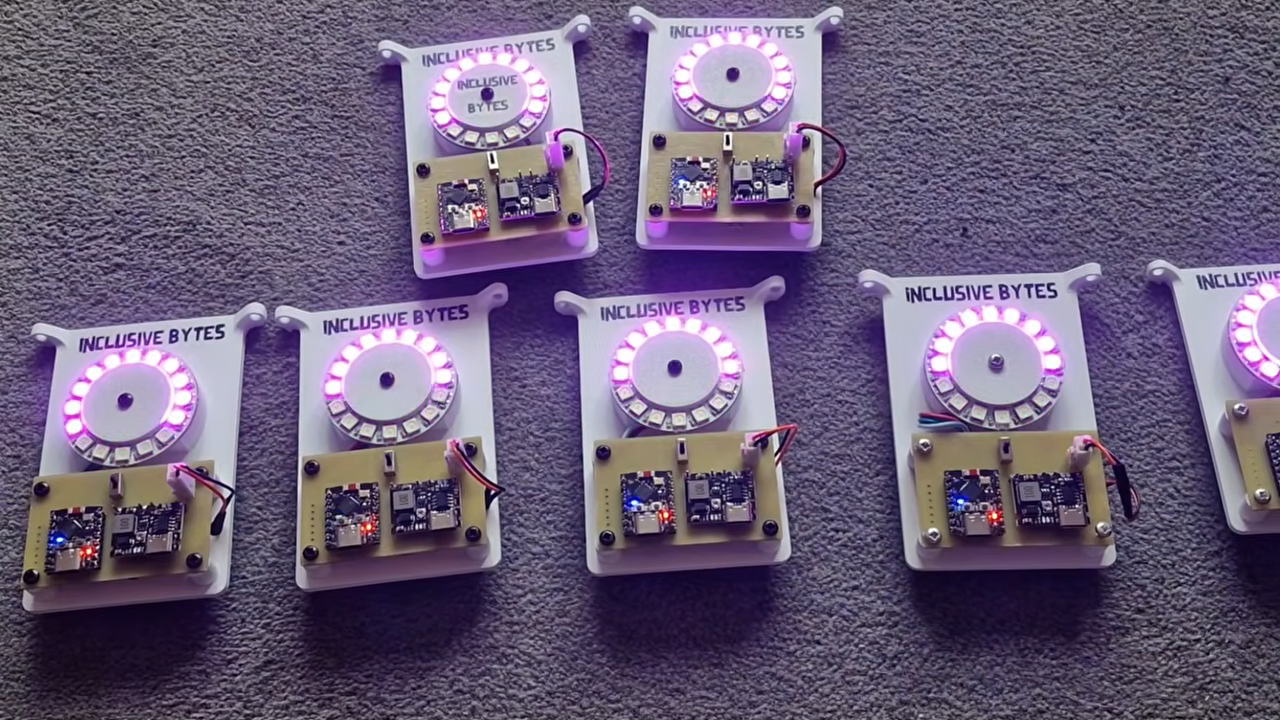
Goacher’s approach eliminates that complexity entirely. His design is open-source, with all files available on GitHub for anyone to replicate or modify. It builds on the ESP-NOW protocol, which allows direct peer-to-peer communication without a Wi-Fi network, making it ideal for ad‑hoc synchronization in large crowds.

What This Means
This self-syncing technique could lower the barrier for DIY interactive wearables at events. Without the need for central control, groups can create synchronized light shows using inexpensive, off-the-shelf hardware.
On a broader scale, the same distributed negotiation principle could be applied to other wireless sensor networks where timing alignment is critical—such as drone swarms, environmental monitoring, or stage lighting. The open-source nature invites experimentation and rapid iteration.
Goacher’s badges demonstrate that robust synchronization can emerge from simple local rules, potentially inspiring new designs for crowd engagement and decentralized IoT systems. The project files are available on GitHub, and a video demonstration is included below.
Related Articles
- How to Prioritize and Apply Microsoft's March 2026 Patch Tuesday Updates
- 7 Key Insights on Exploits and Vulnerabilities from Q1 2026
- Critical RCE Vulnerability in xrdp: Analysis of CVE-2025-68670 and Mitigation Steps
- How to Leverage AI for Zero-Day Discovery: Lessons from Firefox's 271 Vulnerability Hunt
- 7 Critical Facts About Phishing Attacks via Amazon SES
- The Double-Edged Sword: How a DDoS Protection Firm Became the Source of Massive Attacks on Brazilian ISPs
- Massive Canvas Login Portal Breach Hits Hundreds of Colleges – ShinyHunters Strikes Instructure Again
- Ancient Discovery on Velanai Island Rewrites Sri Lanka's Prehistoric Timeline